Design for CNC Machining: DFM Guide
2026-06-04
CNC Plastic Machining Material Selection Guide: POM, Nylon, PTFE, Acrylic and PEEK
2026-06-07
CNC Machining Tolerances Explained: ISO 2768-mK, H7/g6 Fits and Practical Lookup Tables
Tolerances decide whether a machined part simply looks correct or actually assembles, seals, slides, rotates and lasts in the real machine. This guide explains how machining tolerances work, when ISO 2768-mK is useful, and how to read common H7/g6 fit values for shafts and holes.
What Are CNC Machining Tolerances?
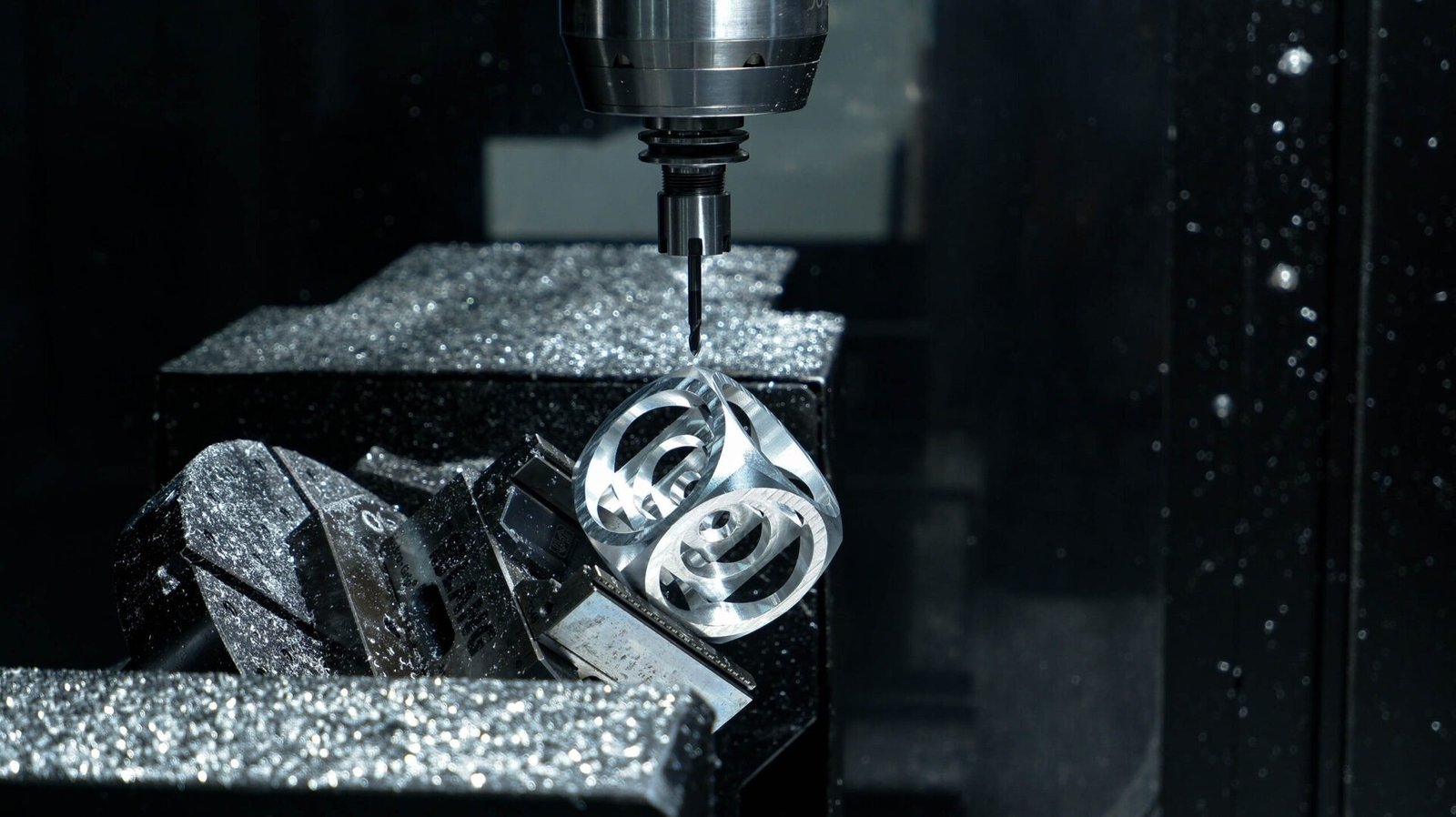
In CNC machining, a tolerance is the acceptable amount of variation from a target dimension, geometry or surface requirement. A drawing may call for a 20.00 mm diameter, but no production process makes every part exactly 20.000000 mm. The tolerance tells the machinist and inspector how much variation is allowed while the part still performs its function.
A tolerance can apply to length, diameter, hole size, position, flatness, perpendicularity, roundness, runout, thread depth, surface finish and many other features. For a simple cover plate, a general tolerance may be enough. For a shaft, bearing seat, sealing groove or press-fit pin, the tolerance must be much more specific.
Why Tolerance Selection Matters
Tighter tolerance is not always better. A very tight tolerance can increase machining time, tool wear, inspection cost and scrap risk. A loose tolerance can reduce cost, but it may cause vibration, leakage, assembly problems or premature wear. Good tolerance design balances function, manufacturability and inspection.
- Function: Does the part need to locate, slide, clamp, seal or rotate?
- Material behavior: Aluminum, brass, stainless steel and engineering plastics react differently to cutting force, heat and stress relief.
- Process capability: CNC milling, turning, grinding, reaming and EDM have different practical accuracy ranges.
- Inspection method: The tolerance should be measurable with suitable gauges, CMM, micrometers or surface instruments.
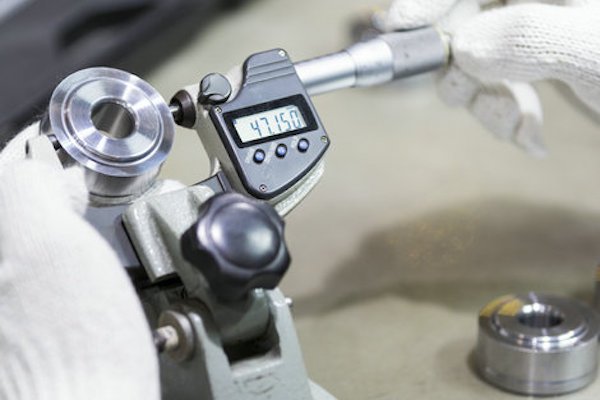
General Tolerance vs Specific Tolerance
Most engineering drawings use both. A title block may state a general standard such as ISO 2768-mK for non-critical dimensions. Critical features then receive their own tolerance callouts, fits or GD&T controls. This keeps the drawing readable while still protecting important interfaces.
| Requirement type | Best use | Typical drawing method | Example |
|---|---|---|---|
| General tolerance | Non-critical lengths, widths, heights and simple features | Title block note | ISO 2768-mK |
| Specific dimensional tolerance | Functional diameters, slots, steps and depths | Dimension-level tolerance | 25.00 ±0.02 mm |
| Limits and fits | Shaft-hole assemblies, bearing seats, bushings and pins | ISO fit symbol | Hole H7 / Shaft g6 |
| Geometrical tolerance | Flatness, perpendicularity, position, runout and symmetry | GD&T frame or ISO 2768-2 class | Perpendicularity 0.04 to datum A |
Practical rule: apply tight tolerance only where it protects assembly, movement, sealing, alignment or service life. Leave non-functional features under a sensible general tolerance.
Standard Tolerances by Manufacturing Process
Standard manufacturing tolerances are not identical across processes. CNC machining can usually hold tighter and more repeatable dimensions than many forming, casting or additive processes, but the exact result still depends on part size, material, tool access, wall thickness, setup stability and inspection method. This is why a drawing should not apply one tight tolerance to every feature by default.
The table below gives practical engineering guidance for early design and quoting. Final acceptance should always follow the drawing, agreed inspection plan and customer specification.
| Manufacturing process | Typical tolerance expectation | Best use | Design caution |
|---|---|---|---|
| CNC milling | Good for controlled pockets, faces, slots and hole patterns | Aluminum housings, brackets, plates, manifolds and precision fixtures | Deep pockets, thin walls and long tools can reduce accuracy |
| CNC turning | Very suitable for round diameters, bores, threads and concentric features | Shafts, pins, bushings, nozzles, fittings and spacers | Long slender shafts may need support to control deflection and runout |
| Grinding / lapping | Used when very tight size, flatness or surface finish is required | Bearing seats, sealing faces, gauge-like parts and hardened components | Add cost and lead time; reserve for truly critical surfaces |
| Sheet metal fabrication | Usually looser than machined features, especially after bending | Covers, brackets, enclosures and formed panels | Bend radius, material springback and hole-to-bend distance matter |
| Casting / die casting | Good for near-net shape, often followed by machining on critical surfaces | Housings, frames, handles and complex shapes | Critical holes, sealing faces and datum pads often need secondary machining |
| 3D printing | Useful for prototypes and complex shapes, but dimensional variation can be larger | Concept models, fixtures, lightweight structures and low-load prototypes | Post-machining may be needed for accurate holes, threads and mating surfaces |
How tighter tolerances affect cost
Tight tolerance usually means more than a slower CNC program. It can require better raw material, stress relief, extra setups, shorter tools, finishing passes, controlled temperature, more inspection points and a higher scrap allowance. When a tolerance is functional, the extra cost is justified. When it is applied to a non-critical feature, it can increase price without improving the product.
Finishing passes, slower feeds and tool changes may be needed to hold tight dimensions.
CMM reports, gauges and documented measurements add quality control work.
Thin walls, difficult materials and tight GD&T can increase scrap or rework risk.
ISO 2768-mK Tolerance Lookup Tables
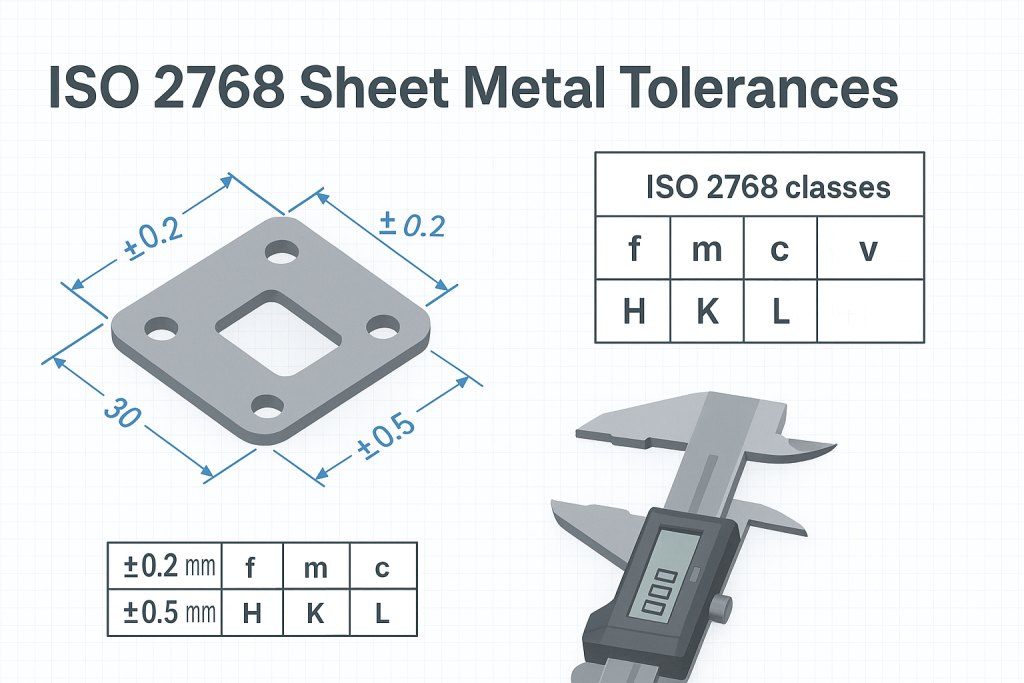
ISO 2768 is commonly used for machined parts when individual tolerances are not shown next to every dimension. The notation ISO 2768-mK usually combines class m for general linear/angular dimensions and class K for general geometrical tolerances. The tables below are practical reference values for quoting and design review; always confirm the active drawing note and customer specification for final acceptance.
ISO 2768-1 Class m: Linear Dimensions
| Nominal dimension range (mm) | Permissible deviation, class m | Common machining use |
|---|---|---|
| 0.5 to 3 | ±0.10 mm | Small steps, shallow pockets, minor details |
| Over 3 to 6 | ±0.10 mm | Small widths, grooves and bosses |
| Over 6 to 30 | ±0.20 mm | General milled and turned features |
| Over 30 to 120 | ±0.30 mm | Plate length, block size, bracket dimensions |
| Over 120 to 400 | ±0.50 mm | Large housings, frames and covers |
| Over 400 to 1000 | ±0.80 mm | Long machined structures |
| Over 1000 to 2000 | ±1.20 mm | Large fabrication-machining parts |
| Over 2000 to 4000 | ±2.00 mm | Oversized assemblies and long plates |
ISO 2768-1 Class m: External Radii and Chamfer Heights
| Nominal radius/chamfer range (mm) | Permissible deviation, class m | Design note |
|---|---|---|
| 0.5 to 3 | ±0.20 mm | Small edge breaks and chamfers |
| Over 3 to 6 | ±0.50 mm | Functional but non-sealing chamfers |
| Over 6 | ±1.00 mm | Large radii where appearance or clearance is the main purpose |
ISO 2768-1 Class m: Angular Dimensions
| Shorter side length of angle (mm) | Permissible deviation, class m | Typical interpretation |
|---|---|---|
| Up to 10 | ±1° | Small chamfers and angled details |
| Over 10 to 50 | ±0°30′ | General machined angles |
| Over 50 to 120 | ±0°20′ | Medium machined faces |
| Over 120 to 400 | ±0°10′ | Long angled faces and brackets |
| Over 400 | ±0°5′ | Large components where angular error becomes magnified |
ISO 2768-2 Class K: General Geometrical Tolerances
| Control type | Nominal length range (mm) | Class K tolerance | Where it matters |
|---|---|---|---|
| Straightness / flatness | Up to 10 | 0.05 mm | Short sealing faces, small blocks |
| Straightness / flatness | Over 10 to 30 | 0.10 mm | Small plates and brackets |
| Straightness / flatness | Over 30 to 100 | 0.20 mm | Machined pads and mounting areas |
| Straightness / flatness | Over 100 to 300 | 0.40 mm | Medium mounting faces |
| Straightness / flatness | Over 300 to 1000 | 0.60 mm | Large plates and frames |
| Straightness / flatness | Over 1000 to 3000 | 0.80 mm | Long structures |
| Perpendicularity | Up to 100 | 0.40 mm | General vertical faces and shoulders |
| Perpendicularity | Over 100 to 300 | 0.60 mm | Medium housings and brackets |
| Perpendicularity | Over 300 to 1000 | 0.80 mm | Large machined assemblies |
| Perpendicularity | Over 1000 to 3000 | 1.00 mm | Oversized structures |
| Symmetry | Up to 100 | 0.60 mm | General centered features |
| Symmetry | Over 100 to 300 | 0.80 mm | Slots, bosses and profiles |
| Symmetry | Over 300 to 1000 | 1.00 mm | Large centered geometry |
| Symmetry | Over 1000 to 3000 | 1.20 mm | Long frames and covers |
| Circular runout | All applicable ranges | 0.20 mm | General rotating features when no tighter callout is given |
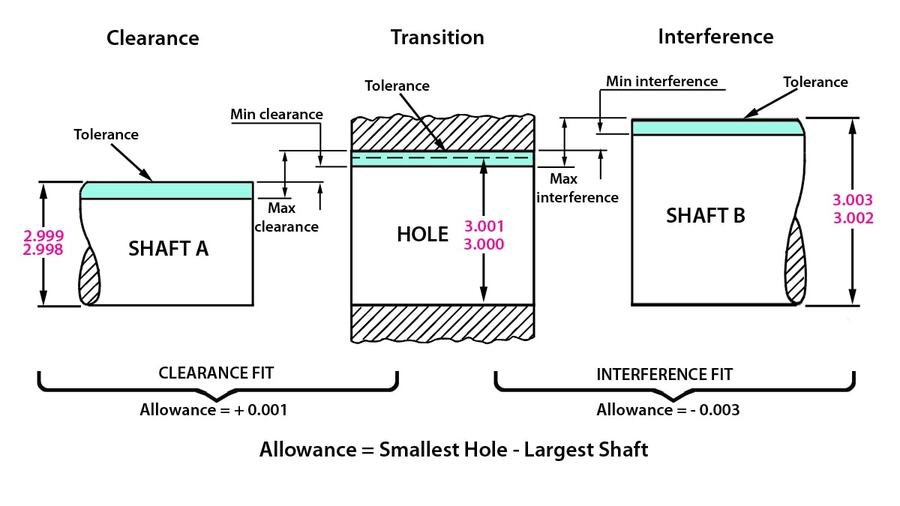
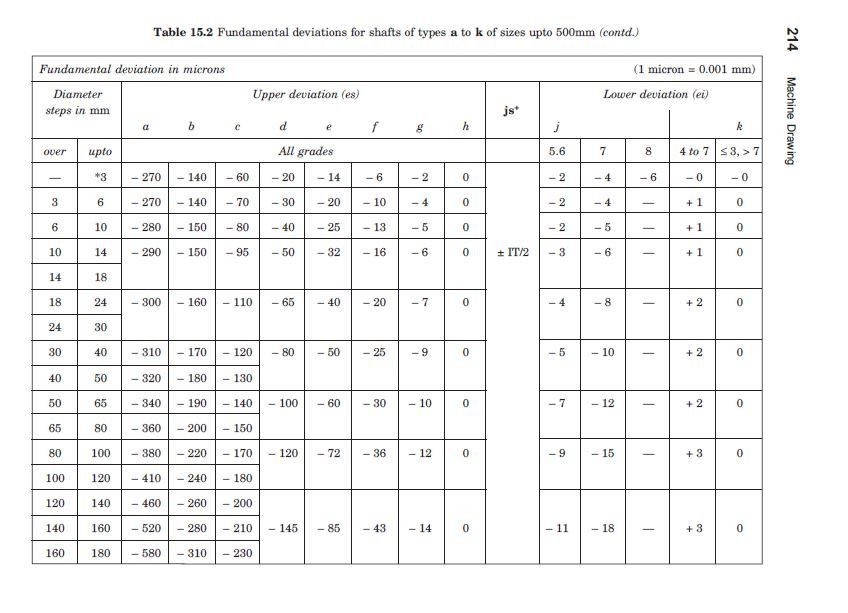
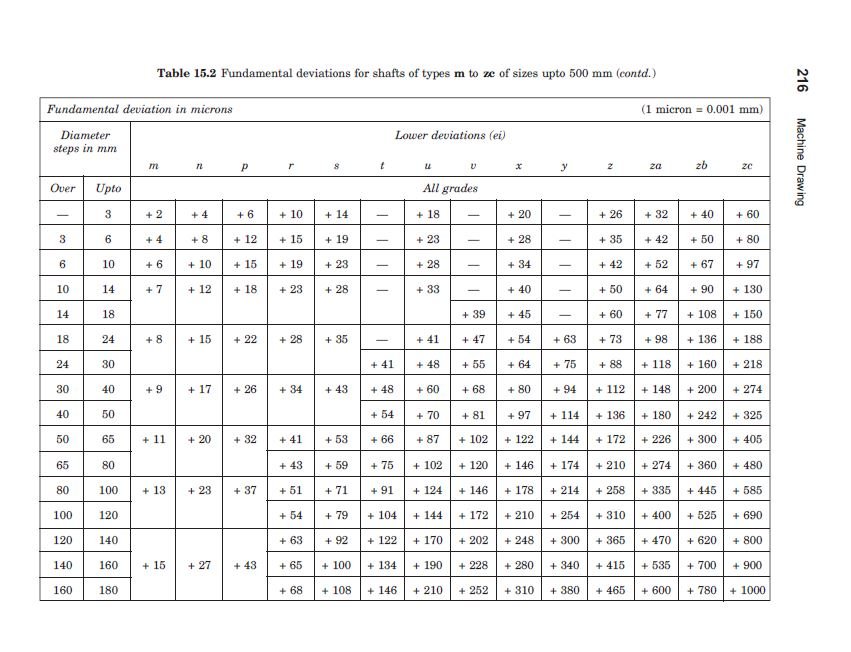

ISO 286 H7/g6 Tolerance Lookup Table for Common Shaft-Hole Fits
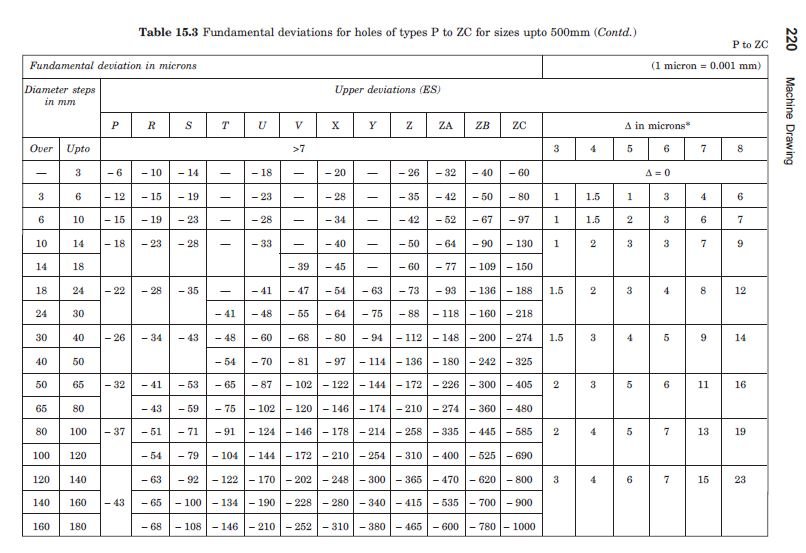
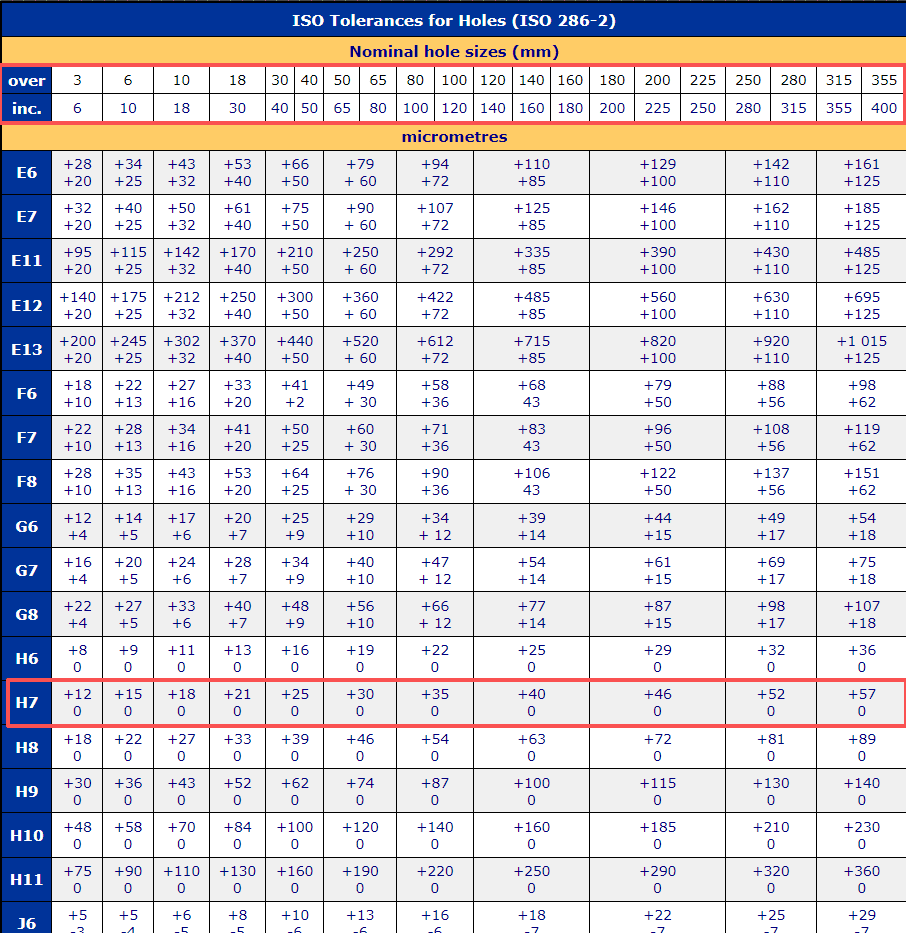
For round features, drawings often use fit symbols instead of writing a plus/minus tolerance. In a typical H7/g6 fit, the hole uses H7 and the shaft uses g6. This usually creates a small clearance fit: the shaft is slightly smaller than the hole, helping assembly while still controlling location.
The values below are common ISO 286 reference values in micrometers. Convert micrometers to millimeters by dividing by 1000. For example, +18 µm equals +0.018 mm.
| Nominal size range (mm) | H7 hole deviation (µm) | g6 shaft deviation (µm) | Approx. clearance range (µm) | Typical application |
|---|---|---|---|---|
| 1 to 3 | 0 / +10 | -8 / -2 | 2 to 18 | Small precision pins |
| Over 3 to 6 | 0 / +12 | -12 / -4 | 4 to 24 | Small shafts and guide pins |
| Over 6 to 10 | 0 / +15 | -14 / -5 | 5 to 29 | Dowel-like locating shafts |
| Over 10 to 18 | 0 / +18 | -17 / -6 | 6 to 35 | Bushings and precise sliding fits |
| Over 18 to 30 | 0 / +21 | -20 / -7 | 7 to 41 | Light-duty rotating shafts |
| Over 30 to 50 | 0 / +25 | -25 / -9 | 9 to 50 | General shaft-hole assemblies |
| Over 50 to 80 | 0 / +30 | -29 / -10 | 10 to 59 | Bearing-related turned features |
| Over 80 to 120 | 0 / +35 | -34 / -12 | 12 to 69 | Large precision shafts |
| Over 120 to 180 | 0 / +40 | -39 / -14 | 14 to 79 | Large clearance fits |
| Over 180 to 250 | 0 / +46 | -44 / -15 | 15 to 90 | Heavy equipment components |
| Over 250 to 315 | 0 / +52 | -49 / -17 | 17 to 101 | Large machined shafts |
| Over 315 to 400 | 0 / +57 | -54 / -18 | 18 to 111 | Large precision assemblies |
| Over 400 to 500 | 0 / +63 | -60 / -20 | 20 to 123 | Oversized shaft-hole interfaces |
For fit-critical parts, do not rely only on a general tolerance block. Call out the fit, datum structure, surface finish, heat treatment and inspection method where they affect assembly or performance.
Geometric Dimensioning and Tolerancing (GD&T)
| Symbol | Characteristics | Categories |
|---|---|---|
| ━ | Straightness | Form |
| ▱ | Flatness | |
| ○ | Circularity | |
| ⌭ | Cylindricity | |
| ∠ | Angularity | Orientation |
| ⊥ | Perpendicularity | |
| ∥ | Parallelism | |
| ⌖ | Position | Location |
| ↗ | Circular Runout | Runout |
| ⌰ | Total Runout | |
| ⌒ | Profile of a Line | Profile |
| ⌓ | Profile of a Surface |
Common Tolerance Mistakes to Avoid
| Mistake | Why it causes problems | Better approach |
|---|---|---|
| Using ±0.01 mm everywhere | Raises cost and inspection burden without improving non-critical features | Reserve tight tolerance for functional areas |
| Relying only on size tolerance | A hole can be the right diameter but in the wrong position or not perpendicular | Add position, perpendicularity or runout controls where needed |
| No material/process discussion | Thin walls, stainless steel and plastics may move during machining | Review material, wall thickness and fixture strategy early |
| Surface finish omitted | Sliding, sealing and rotating features may fail even when size is correct | Specify Ra value and inspection area |
| Inspection method unclear | Supplier and customer may measure differently | Agree gauges, CMM strategy, sampling plan and datum setup |
How to Specify Machining Tolerances on a Drawing
A clear tolerance strategy helps the supplier machine the part correctly and inspect it in the same way the engineer expects. The most effective drawings separate general manufacturing requirements from critical functional requirements. This avoids both under-tolerancing and over-tolerancing.
A practical workflow
- Start with the function of the part and identify critical interfaces.
- Use ISO 2768-mK or another general standard for non-critical dimensions.
- Apply H7, g6, h7, H8 or other ISO fit symbols to functional shaft-hole features.
- Add GD&T where size tolerance alone cannot control orientation, position or runout.
- Define surface finish when the part seals, slides, rotates or contacts another precision component.
- State whether tolerances apply before or after plating, anodizing, heat treatment or polishing.
- Agree on CMM, gauge or sampling requirements for first article and production inspection.
What to send for quoting
For faster quotation and fewer engineering questions, send both 2D and 3D files. The 3D model helps confirm geometry and tool access, while the 2D drawing controls tolerances, materials, threads, finish and inspection notes.
| File / note | Why it matters |
|---|---|
| 2D PDF drawing | Defines tolerance notes, GD&T, material, finish and revision control |
| STEP / IGS / X_T model | Supports CAM programming, tool access review and 3D geometry checking |
| Critical dimension list | Shows which features need the most attention in machining and inspection |
| Assembly context | Helps choose clearance fit, transition fit, press fit or location strategy |
| Inspection requirement | Clarifies whether full CMM report, FAI report or normal production inspection is needed |
What Tolerance Can Milemetal Support?
Milemetal manufactures custom CNC machining parts, CNC turned parts, milling components, shafts, pins, bushings, fittings, aluminum parts, stainless steel parts and brass components for industrial applications. The best achievable tolerance depends on feature size, material, part geometry, surface finish, batch quantity and inspection plan.
For standard CNC machining work, it is usually efficient to use general tolerances for non-critical geometry and tighter feature-level tolerances for functional interfaces. For high-precision turned parts, bearing-related features and custom shaft-hole assemblies, we can review H7/g6, h7, H8, press-fit and clearance-fit requirements during quoting.
Send these details for a faster tolerance review
- 2D drawing with tolerance notes and material specification
- 3D model in STEP, IGS or X_T format
- Annual or batch quantity
- Critical-to-quality dimensions and inspection requirements
- Surface treatment such as anodizing, plating, passivation or polishing
FAQ: CNC Machining Tolerances
What are standard tolerances in manufacturing?
Standard tolerances are default acceptable deviations used when a drawing does not specify a feature-level tolerance. They help suppliers manufacture and inspect non-critical dimensions consistently. For CNC machined parts, ISO 2768 is often used as a general tolerance standard, while critical fits and GD&T features should be called out separately.
Are standard tolerances the same for CNC machining, sheet metal and casting?
No. Different manufacturing processes have different practical accuracy ranges. CNC machining is usually better for tight controlled features, while sheet metal bending, casting and 3D printing often need looser expectations or secondary machining for critical interfaces.
Is ISO 2768-mK enough for precision CNC parts?
It is enough for many non-critical features, but not for every precision requirement. Shaft fits, bearing seats, sealing faces, threaded interfaces, locating holes and high-speed rotating parts often need their own dimension-level tolerance, fit symbol, surface finish or GD&T callout.
What is the difference between H7 and g6?
H7 describes a hole tolerance zone whose lower deviation is zero. g6 describes a shaft tolerance zone positioned below the nominal size. Together, H7/g6 usually creates a controlled clearance fit for accurate assembly.
Should I choose the tightest tolerance possible?
No. Choose the tolerance that the function requires. Over-tolerancing increases cost and can slow production. Under-tolerancing can create assembly and reliability risks. The best drawing separates critical features from general features.
Can surface treatment change final dimensions?
Yes. Anodizing, plating, coating, heat treatment and passivation can affect final dimensions or measurement conditions. If a feature is fit-critical after treatment, the drawing should clearly define whether the tolerance applies before or after finishing.
Need a tolerance review for a CNC part?
Send your drawing and 3D model. Milemetal can review the tolerance notes, fit requirements, machining process and inspection approach before production.