
Sheet Metal Materials Selection Guide
2026-06-15
Sheet Metal Fabrication Overview: Processes and Design Guide
2026-06-15
Sheet Metal Thickness Gauge Chart: Convert Gauge to mm and Inches for Steel, Aluminum, Stainless, Brass and Copper
Sheet metal gauge numbers are widely used in drawings, quotations and material purchasing, but gauge is not a direct thickness unit. A 16 gauge steel sheet is not the same thickness as 16 gauge aluminum, stainless steel, brass or copper. This guide explains how to read sheet metal gauge charts, compare material thickness, convert gauge to mm and inches, and avoid design mistakes in laser cutting, bending and fabrication.
What Does Sheet Metal Gauge Mean?
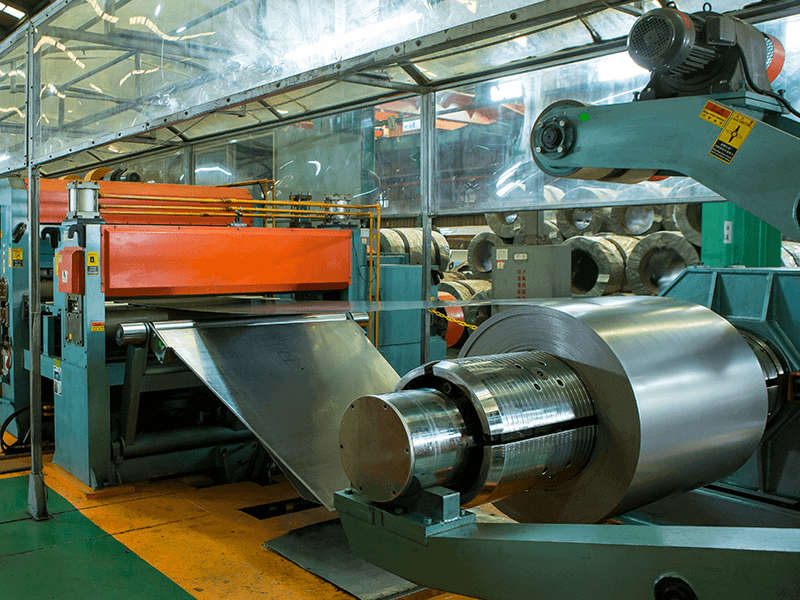
Sheet metal gauge is a numbering system used to describe sheet thickness. It is common in steel, galvanized steel, stainless steel, aluminum, brass and copper purchasing, especially in North America. The confusing part is that gauge is not universal. The same gauge number can mean different thicknesses depending on the material family.
For example, 16 gauge standard steel is about 1.519 mm thick, while 16 gauge aluminum is about 1.290 mm and 16 gauge copper is about 1.651 mm. This is why engineering drawings should avoid using gauge alone for critical parts. The drawing should state the material grade and actual thickness in millimeters or inches.
16 gauge steel, aluminum and copper do not have the same thickness.
20 gauge is thinner than 16 gauge, and 26 gauge is thinner than 20 gauge.
Bend radius, bend force, hole distance, flange length and weight all depend on real thickness.



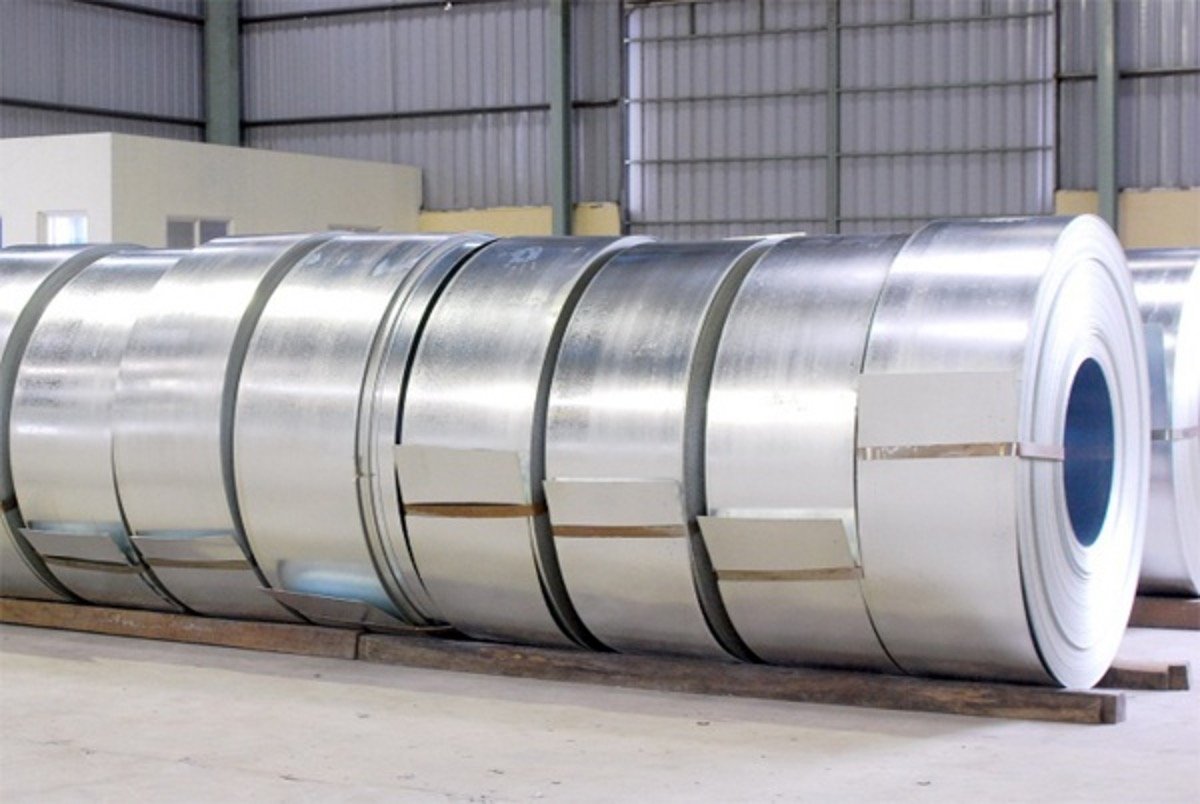
Sheet Metal Thickness Gauge Chart
The chart below compares common gauge numbers across standard steel, galvanized steel, stainless steel, aluminum, brass and copper sheets. It is useful for quick conversion, but production drawings should still list the exact thickness and material standard.
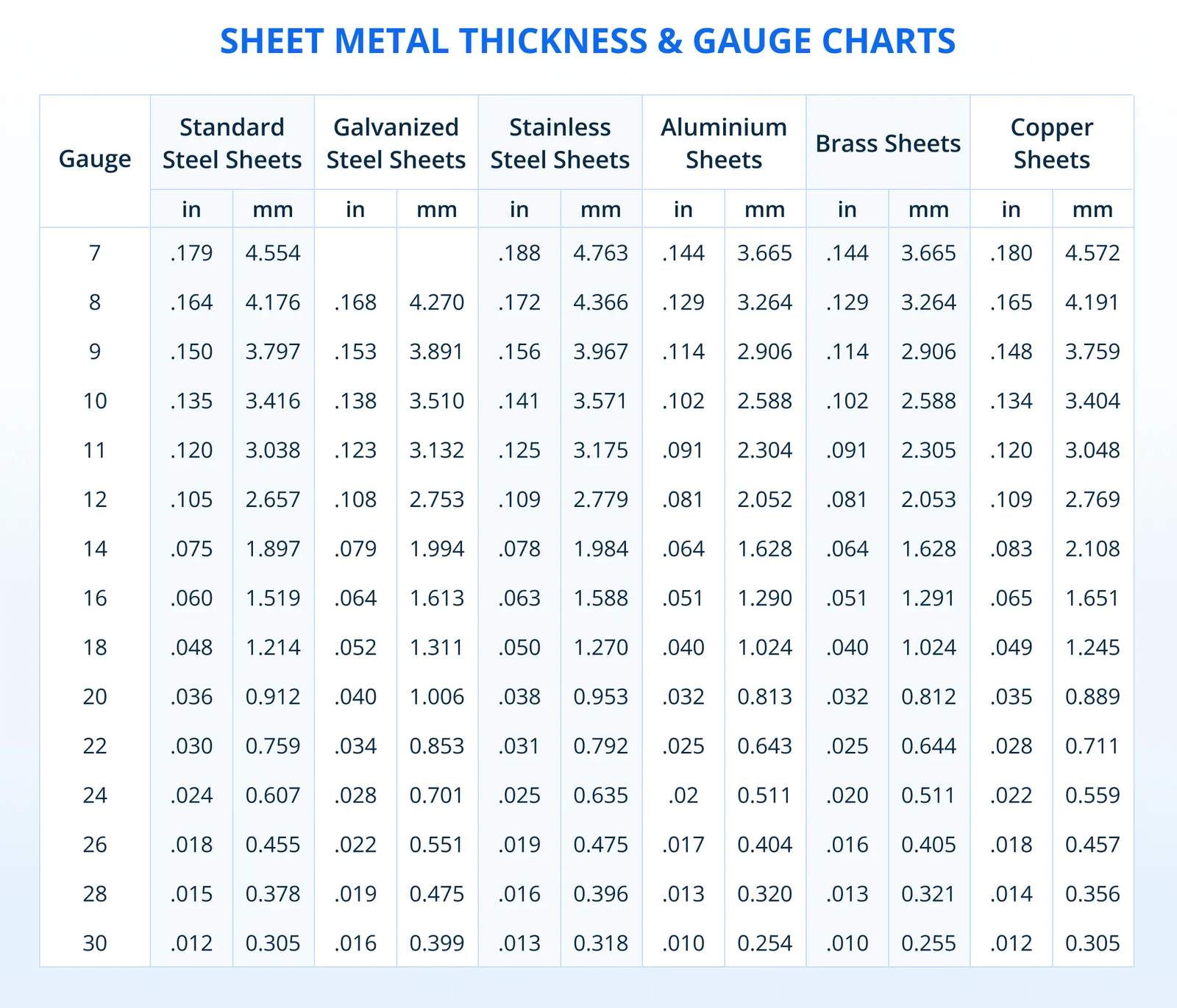
Common Gauge to Thickness Conversion Table
This HTML table includes frequently used gauge values so the data can be read directly by users and search engines. Values are approximate reference thicknesses.
| Gauge | Standard steel mm | Galvanized steel mm | Stainless steel mm | Aluminum mm | Brass mm | Copper mm |
|---|---|---|---|---|---|---|
| 7 | 4.554 | – | 4.763 | 3.665 | 3.665 | 4.572 |
| 8 | 4.176 | 4.270 | 4.366 | 3.264 | 3.264 | 4.191 |
| 9 | 3.797 | 3.891 | 3.967 | 2.906 | 2.906 | 3.759 |
| 10 | 3.416 | 3.510 | 3.571 | 2.588 | 2.588 | 3.404 |
| 11 | 3.038 | 3.132 | 3.175 | 2.304 | 2.305 | 3.048 |
| 12 | 2.657 | 2.753 | 2.779 | 2.052 | 2.053 | 2.769 |
| 14 | 1.897 | 1.994 | 1.984 | 1.628 | 1.628 | 2.108 |
| 16 | 1.519 | 1.613 | 1.588 | 1.290 | 1.291 | 1.651 |
| 18 | 1.214 | 1.311 | 1.270 | 1.024 | 1.024 | 1.245 |
| 20 | 0.912 | 1.006 | 0.953 | 0.813 | 0.812 | 0.889 |
| 22 | 0.759 | 0.853 | 0.792 | 0.643 | 0.644 | 0.711 |
| 24 | 0.607 | 0.701 | 0.635 | 0.511 | 0.511 | 0.559 |
| 26 | 0.455 | 0.551 | 0.475 | 0.404 | 0.405 | 0.457 |
| 28 | 0.378 | 0.475 | 0.396 | 0.320 | 0.321 | 0.356 |
| 30 | 0.305 | 0.399 | 0.318 | 0.254 | 0.255 | 0.305 |
Thickness Trend Chart: Standard Steel Gauge
The chart below shows how standard steel thickness decreases as gauge number increases. This reverse relationship is the main reason gauge charts should be checked carefully.
How Sheet Thickness Affects Fabrication
Actual sheet thickness affects nearly every fabrication decision. It changes laser cutting kerf strategy, punching clearance, press brake tooling, minimum bend radius, minimum flange length, hole-to-bend distance, weld heat input, fastener selection and part weight. A small gauge change can create a large difference in stiffness and forming force.
| Design factor | Why thickness matters | Practical rule |
|---|---|---|
| Bend radius | Thicker sheets generally need larger inside radii to avoid cracking and tooling overload | Start near R = T for ductile materials, larger for stainless or hard aluminum |
| Minimum flange length | Short flanges may not sit correctly in the V-die | Use roughly 4T plus bend radius as an early check |
| Hole distance from bend | Holes near bends can stretch or distort | Keep hole edge at least 2.5T + R from the bend tangent when possible |
| Weight | Thickness directly changes part mass and shipping cost | Use thickness only as high as the load, stiffness and durability require |
| Stiffness | Stiffness increases strongly with thickness and section shape | Add bends, ribs or flanges before simply increasing thickness |
| Fasteners | Threads, PEM inserts, rivets and weld nuts need adequate sheet thickness | Confirm hardware range against actual material thickness, not only gauge number |
Design Rules for Using Gauge on Drawings
State exact thickness
List material and thickness in mm or inches, even if the purchasing team also uses gauge.
Match material family
Do not transfer steel gauge values to aluminum, stainless, brass or copper sheets.
Define tolerance
Sheet stock has thickness tolerance. Critical assemblies should allow normal material variation.
Review forming
Thickness drives bend radius, flange length, springback, tooling and forming force.
- Use gauge charts for reference, not as the only engineering specification.
- When replacing material, compare actual thickness, not only gauge number.
- Check bend radius and hole-to-bend distance after changing thickness.
- Account for coating thickness if parts are powder coated, plated or galvanized.
- For weight-sensitive products, compare density and thickness together.
- For load-bearing parts, consider stiffness, material grade and formed shape, not thickness alone.
FAQ: Sheet Metal Gauge and Thickness
Is 16 gauge the same thickness for all metals?
No. 16 gauge standard steel is about 1.519 mm, stainless steel is about 1.588 mm, aluminum is about 1.290 mm, brass is about 1.291 mm and copper is about 1.651 mm.
Does a higher gauge mean thicker sheet metal?
No. In sheet metal, a higher gauge number usually means a thinner sheet. For example, 24 gauge steel is thinner than 16 gauge steel.
Should drawings use gauge or millimeters?
Engineering drawings should specify actual thickness in millimeters or inches, plus material grade and tolerance. Gauge can be added as a purchasing reference if needed.
Why are galvanized steel gauge values different?
Galvanized steel includes a zinc coating, and gauge chart values differ from standard uncoated steel. Always confirm whether the thickness includes coating.
How does thickness affect bending?
Thickness affects bend radius, V-die opening, forming force, springback and minimum hole distance from the bend. Thicker material usually needs larger tooling and higher press force.
Need help choosing sheet metal thickness?
Send your drawing, material, gauge or target thickness, finish and quantity. Milemetal can review thickness, bend radius, feature spacing and manufacturability before production.